I really enjoyed reading Emerson's writing on the American Scholar--there is nothing much better then reading things that you agree with and, better yet, intelligibly illustrate why you agree.
Things I agree with / Need to think more about:
1. Be the "Man on the farm" not the farmer
Don't fall into the habit of defining yourself by your day-to-day activities. Eg, I am Debbi Jones who acts, not an actor.
2. "...all things exist for the student's behoof" because "every man [is] a student"
Hear, hear!
3. "The sacredness which attaches to the act of creation,--the act of thought,--is instantly transferred to the record."
Yes, preservation is important, but to create for the sake of preservation is sick. Eg, many hollywood actors/musicians.
4. "Whatever talents may be, if the man create not, the pure efflux of the Deity is not his..."
USE the gifts God gives and makes SOMETHING.
5. "When he can read God directly, the hour is too precious to be wasted in other men's transcripts of their readings."
Listening to God is more important than reading the works of the wisest men--unless you're hearing God through their words. But it's better to just simply focus on listening to God firsthand.
6. "...as the human body can be nourished on any food...the human mind can be fed by any knowledge."
All knowledge is enlightening knowledge to help you grow.
7. "Life is our dictionary."
Learn by living.
8. "The artist...has always the resource to live."
Be inspired by living.
9. "Fear always springs from ignorance."
Eg, homophobes.
10. "The world is his who can see through it's pretension."
Look past appearances, and you will know it's nature.
Summed up: Live to learn, create to create, and seek to understand.
Tuesday, April 17, 2012

Saturday, April 14, 2012
Reflections and Stuff
From this section, my three favorite statements just so happen to all take place on page 493. And because they are my favorites, they will be the topic of this blog.
Emerson makes a bold assertion (surprise surprise) right away in the introduction of his writings on Nature. He states, "Undoubtedly we have no questions to ask which are unanswerable."
This one statement really struck me. For there are plenty of mysteries in Christianity and there are plenty of questions that only God knows the answers to in life. Then again, however, he's not exactly saying we know the right answer to every question. He's just saying there's an answer to every question whether we know it or it's right or wrong. And that we might as well explore the possibilities.
Cool. Glad I answered my own question.
Another very striking statement occurred on the same page, in Chapter 1. "To go into solitude, a man needs to retire as much from his chamber as from society."
Wise man, for this statement is even more true today with the ever-presence of technology. When I'm surrounded by my cool stuff, there’s no way that I can possibly reflect on anything outside of the cool stuff and the memories that are associated with it. And what really is stuff to us anyway? What do we really need? My cool stuff is cool and pretty and artistic—especially my clothes. But there’s a difference between stuff for art’s sake and stuff for stuff’s sake. My stuff is such a wonderful distraction from real thought.

Emerson makes a bold assertion (surprise surprise) right away in the introduction of his writings on Nature. He states, "Undoubtedly we have no questions to ask which are unanswerable."
This one statement really struck me. For there are plenty of mysteries in Christianity and there are plenty of questions that only God knows the answers to in life. Then again, however, he's not exactly saying we know the right answer to every question. He's just saying there's an answer to every question whether we know it or it's right or wrong. And that we might as well explore the possibilities.
Cool. Glad I answered my own question.
Another very striking statement occurred on the same page, in Chapter 1. "To go into solitude, a man needs to retire as much from his chamber as from society."
Wise man, for this statement is even more true today with the ever-presence of technology. When I'm surrounded by my cool stuff, there’s no way that I can possibly reflect on anything outside of the cool stuff and the memories that are associated with it. And what really is stuff to us anyway? What do we really need? My cool stuff is cool and pretty and artistic—especially my clothes. But there’s a difference between stuff for art’s sake and stuff for stuff’s sake. My stuff is such a wonderful distraction from real thought.
Emerson adds to this thought:
"The stars awaken a certain reverence, because though always
present, they are always inaccessible…"
It’s time I learn to appreciate this reverence and not fear it, hiding
away in the comforts of my cozy dorm room.

Sleepy Story Time
 Reading Irving's Rip Van Winkle was so ridiculously refreshing. Finally, we got to read some magical and fun-filled fiction. Irving's life sounded like such an adventure--there's no doubt in my mind that all of his travels inspired and spurred his imagination. My dad also wanted me to be a lawyer. Huzzah for creativity and passion!
I love that, even after almost two centuries, Irving's humor is clearly stated throughout the text. He has a lot of really good sound bites. I scribbled a ridiculous amount of smiley faces into my textbook. So, this blog will consist of my favorite Van Winkle quotes.
"...a curtain lecture is worth all the sermons in the world for teaching the virtues of patience and long suffering." A "curtain lecture" is a talk given after the curtains of a fourposter bed are drawn at night. (456)
"... what courage can withstand the ever-during and all-besetting terrors of a woman's tongue?" (458)
"...a sharp tongue is the only edge tool that grows keener by constant use." (458) It's funny because it's true!
"...yet there was something strange and incomprehensible about the unknown, that inspired awe, and checked familiarity." (460) A reflection of humanity.
Monday, March 12, 2012
Benjamin Franklin
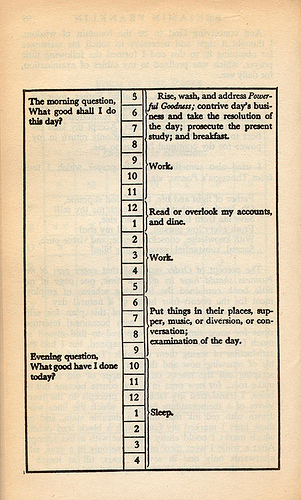
This attitude developed from his foundation, his theology, which also defines a larger part of the American attitude. In our melting pot of a country, Americans are consistently exposed to a whole slew of religions. And who are we to say one is better then the other? To fit in to the melting pot, it is generally best to take a general approach--every religion has some truth to it. As self-made people, we can take care of our own virtue. And this may take the effort of a daily minute by minute schedule, but no pain, no gain.
And there's no doubt that B. Franklin truly did "master" his life--he was and is an international celebrity.
I do wonder though, how different his life may have been if he were a Christian. I mean, obviously, he was a good person anyway and successful too. But still...something to ponder on.
John and Abigail Adams
First of all, what an amazing example for modern day relationships. The strength of their relationship illustrated by their private letters is astounding. "The Letters of John and Abigail Adams" could simply be captioned "Dear Reader, It is Possible--With a Little Effort and Communication."
Second of all, not to sound creepy, but how cool it is to be able to truly stalk a strong and lasting celebrity relationship through letters which actually were written for the personal audience, unlike most of the published early American letters. We get an open and honest look at the life of the early American dynamic of the married life. A look which readers won't ever get now until they are actually married. Or actually stalking. And that actually is creepy.
 The wisdoms presented by their correspondence are epic. Perhaps my favorite letter was "Classical Parallels" written by Abigail to John, particularly her reference to Polybius: "there is nothing more desirable, or advantages than peace, when founded in justice and honour, so there is nothing more shameful and at the same time more pernicious when attained by bad measures, and purchased at the price of liberty."
Abigail is also another representation of the triumph of the human spirit over the circumstance of birth; obviously, as one can tell by her grammatical and spelling errors, she was not conventionally educated. However, she was extremely wise and definitely an effective and important American citizen.
Second of all, not to sound creepy, but how cool it is to be able to truly stalk a strong and lasting celebrity relationship through letters which actually were written for the personal audience, unlike most of the published early American letters. We get an open and honest look at the life of the early American dynamic of the married life. A look which readers won't ever get now until they are actually married. Or actually stalking. And that actually is creepy.

Abigail is also another representation of the triumph of the human spirit over the circumstance of birth; obviously, as one can tell by her grammatical and spelling errors, she was not conventionally educated. However, she was extremely wise and definitely an effective and important American citizen.
J. Hector St. John De Crevecoeur

In his work "Letters from an American Farmer," he truly captures the spirit of America. It's amazing to me to see how truly influenced our society is still today by the attitude of our founders. The "American Dream" is still at play today. Some of his quotes that illustrate this idea include the following:
"...this is the work of my country men who,....afflicted by a variety of of miseries and wants, restless and impatient, took refuge here. They brought along with them their national genius, to which they principally owe what liberty they enjoy and what substance they possess."
America was built upon a foundation of hope for better lives of liberty, formed by people who would not settle for less then they thought they deserved.
"They are a mixture of English, Scotch, Irish, French, Dutch, Germans and Swedes. From this promiscuous breed, that race now called Americans have arisen."
This illustrates that the ideals of the American Dream became an international movement.
"Men are like plants; the goodness and flavor of the fruit proceeds from the peculiar soil and exposition in which they grow."
America is a diverse and huge land--Crevecoeur describes human nature's adaptability to the type of climate and land a person lives in. Kind of like how people often look like the pets they own.
Phillis Wheatly
 If they had reality TV in 1773, I bet Phillis Wheatly would have made a very interesting subject for a series. Her spirit certainly did triumph over her circumstance of birth, especially displayed by the publishing of her poems at age 19(ish) years old.
The first poem in our selection, "On Being Brought from Africa to America" immediately struck me with her first line. 'Twas mercy brought me from my pagan land. How truly amazing her character must have been--to be grateful to have been a slave because she came to know Christ through it. Her poetry is a model for keeping things in perspective. She brings this gratefulness back into play again her next poem, "To the University of Cambridge, in New England." She called students to be fully grateful not only for their exposure to Christianity, but also their education, their resources to scan the heights... [as] sons of science.
I also love her uses of metaphors, particularly in the second stanza of "Thoughts on the Works of Providence." The peerless monarch of the ethereal train. God, as the mightiest of all, has no peer and rules over all of time, which itself is a graceful piece of art.
Basically, Phillis Wheatly is really cool and I would have wanted to be her friend. Inspiration for humanity!
I also love her uses of metaphors, particularly in the second stanza of "Thoughts on the Works of Providence." The peerless monarch of the ethereal train. God, as the mightiest of all, has no peer and rules over all of time, which itself is a graceful piece of art.
Basically, Phillis Wheatly is really cool and I would have wanted to be her friend. Inspiration for humanity!
Subscribe to:
Posts (Atom)